|
5
min read
What Does a UI/UX Design Agency Actually Do?
When founders or product managers approach a UI/UX design agency, the conversation often starts with a specific visual request. "We need a fresher look," or "We need to update our dashboard." While these are valid starting points, they barely scratch the surface of the actual value a design partner provides.
In the digital landscape, the gap between what a client sees (the final screens) and what an agency does (the strategic architecture) is significant. In our work, we view design not just as an aesthetic layer, but as a translation of business logic into user behavior.
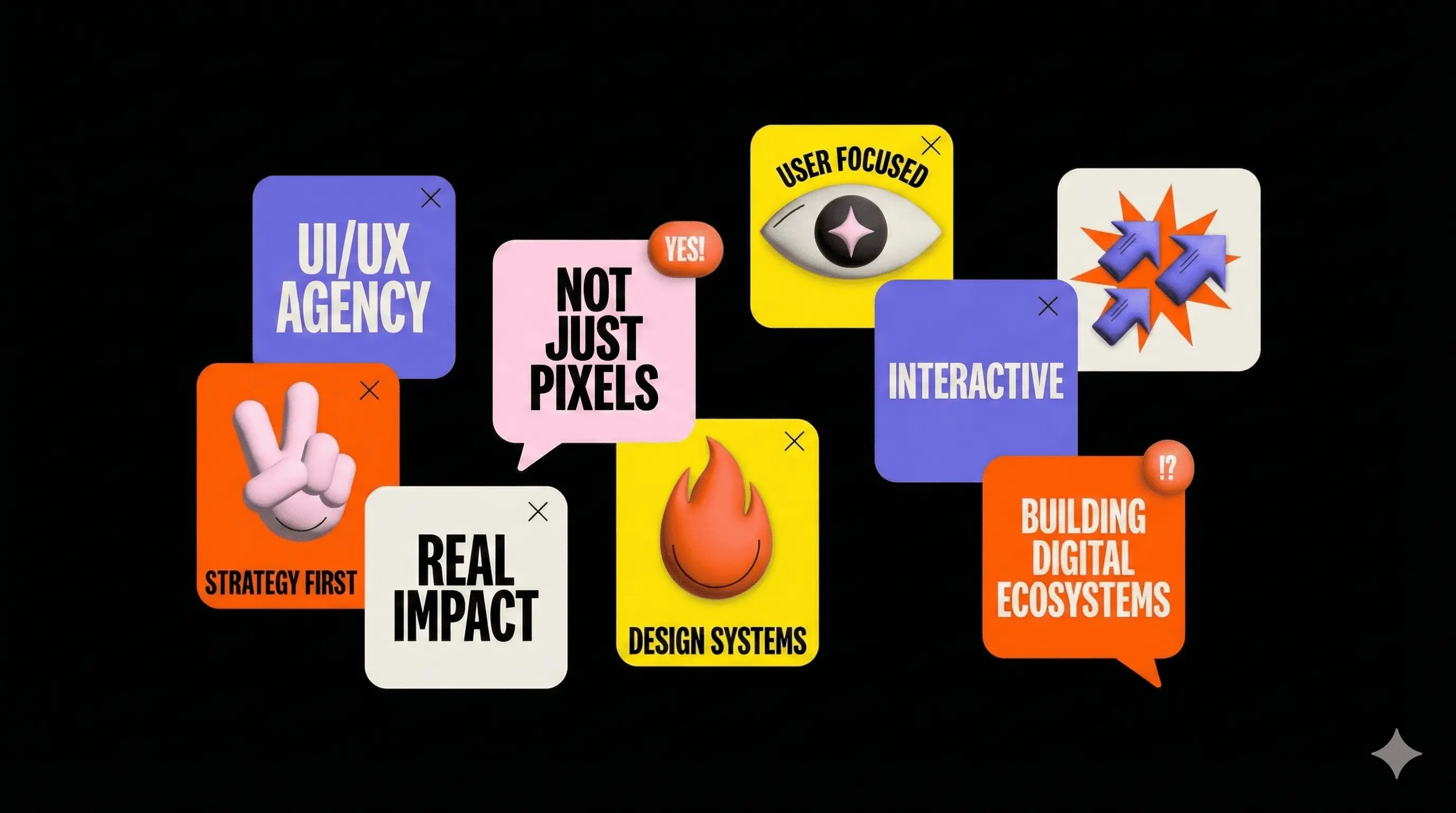
A UI/UX design agency is responsible for shaping how users experience digital products and websites. This includes research, experience strategy, interface design, interaction design, and ongoing optimization—ensuring that business goals translate into intuitive, usable digital systems.
This article breaks down the reality of our role, moving beyond the deliverables to explain how a design agency functions as a strategic partner for product growth.
The Gap Between Visual Design and Product Strategy
The most common misconception we encounter is that a UX design agency role is limited to graphic design applied to software. While aesthetics are critical for trust and brand perception, they are the final step in a much longer chain of decisions.
In practice, a design agency functions more like a product architect. Before a single pixel is placed on a canvas, we must deconstruct the business model. If we are designing a fintech app, we aren't just looking at color palettes; we are looking at trust mechanics. How does the user feel when they link their bank account? What friction points cause them to drop off during onboarding?
A competent agency bridges the gap between the stakeholder’s vision and the user’s reality. We act as a neutral third party that validates assumptions. Often, a client will ask for a specific feature because a competitor has it. Our job is to determine if that feature actually serves the user's goal or if it simply adds cognitive load.
The Real Scope of UI/UX Design Services
To understand the agency model, it helps to categorize the work. Most UI/UX services fall into distinct buckets, though they often overlap in a live project.
In practice, a UI/UX design agency typically delivers:
User research and behavioral insights
Experience strategy and information architecture
Interface and interaction design
Prototypes for testing and validation
Design systems for scalability
Design support during development
The Strategic Layer (UX Research & Architecture)
This is the invisible foundation. It involves mapping out the entire user journey. We rarely start designing screens immediately. Instead, we create user flows and wireframes that prioritize functionality.
For example, in an e-commerce project, the strategic layer involves deciding how many steps it takes to checkout. If we reduce the steps from five to three, we fundamentally change the backend requirements and the frontend experience. This is where business goals are directly tied to design decisions.
The Visual Layer (User Interface Design)
This is where the brand identity comes alive. However, for a digital product, "brand" means more than a logo. It implies a cohesive design system—a library of buttons, fonts, and interaction states that ensures consistency.
When we build UI/UX for businesses, we are creating a scalable language. If a developer needs to add a new feature six months later, they should be able to use the design system we created to build it without breaking the visual consistency of the app.
The Interactive Layer (Motion & Prototyping)
This is often where good agencies differentiate themselves. Static screens cannot communicate how a product feels. Interaction design—how a button responds when clicked, or how a page transitions—provides feedback to the user. It confirms actions and guides attention. We build high-fidelity prototypes to test these interactions before development begins, saving time and resources down the line.
The UI/UX Design Process Is Not Linear
A major point of friction in client-agency relationships often stems from a misunderstanding of the UI/UX design process. Traditional project management views production as a waterfall: Requirement to Design to Approval to Code.
In reality, successful product design is iterative.
When we begin a project, we start with a hypothesis. We design a solution, but that solution must be tested. We might create a low-fidelity wireframe and realize that the navigation structure is too complex. We then circle back, simplify, and try again.
This is why we emphasize "sprints" rather than rigid milestones. A sprint allows us to tackle a specific part of the product—say, the user profile section—design it, review it, and refine it based on immediate feedback. This agile approach prevents the "big reveal" disaster, where an agency spends months working in isolation only to deliver a product that doesn't fit the market need.
Balancing UI and UX Roles
While the terms are often used interchangeably, the roles require different mindsets. In a dedicated agency, these roles collaborate closely but handle different problems.
The UX (User Experience) Focus
The UX perspective is analytical. It asks: "Is this useful?" and "Is this usable?" When we look at a complex SaaS dashboard, the UX focus is on information architecture. How do we organize vast amounts of data so the user isn't overwhelmed? It involves making trade-offs between density and clarity.
The UI (User Interface) Focus
The UI perspective is emotive and structural. It asks: "Is this clear?" and "Does this evoke the right feeling?" The UI designer ensures that the hierarchy established by the UX designer is visually obvious. If the primary action button looks the same as the "cancel" button, the UI has failed the UX.
In our studio, we ensure these two sides are in constant dialogue. A beautiful interface that is impossible to navigate is useless; a highly functional interface that looks untrustworthy will never be adopted.
Practical Insight: What Businesses Misunderstand About UI/UX Agencies
After working with numerous teams, from Bangalore startups to global enterprises, we have identified a specific pattern of friction that usually occurs midway through a project.
The "Hand-off" Myth
Many teams believe that the agency's job ends when the Figma files are handed over to the developers. This is a dangerous assumption.
In practice, the most critical phase of design often happens during development. Design files are static; code is dynamic. When a developer implements a design, edge cases arise. What happens when the user has a name that is 50 characters long? What happens if the internet connection drops?
If the design agency is not involved during the build phase to answer these questions (Design QA), the final product will slowly drift away from the intended design. We often see products that launched with "broken" UIs simply because the developers had to make on-the-fly decisions without design guidance.
The "One-and-Done" Mentality
Another common error is viewing a website or app launch as the finish line. In the digital space, launch is simply Day One. Real user data only starts flowing in after the product is live.
We advise our clients to budget for post-launch iteration. The first version of a product is a best-guess based on research. The second version is based on reality. Agencies that are retained for post-launch optimization—analyzing heatmaps and user sessions—can often double the effectiveness of a product with small tweaks that were impossible to predict before launch.
Why "Good Enough" is a Business Risk
With the rise of template-based builders and AI tools, some businesses question the ROI of a custom UI/UX design agency. Why not just use a standard template?
For simple informational sites, templates are often sufficient. However, for digital products or brands competing in saturated markets, "standard" is invisible.
Custom design is about control. It gives you control over the narrative, the user's attention, and the conversion funnel. A generic template forces your content to fit its structure. A custom design builds a structure around your unique content and business goals.
Furthermore, in competitive markets like the US or India’s tech metros, user expectations are incredibly high. Users judge the credibility of a business within milliseconds of the page loading. If the interaction feels clunky or the layout feels generic, trust is lost immediately.
Frequently Asked Questions
What is the difference between a freelance designer and a UI/UX agency?
A freelancer is an individual contributor usually focused on execution. An agency provides a multidisciplinary team (strategists, UI designers, UX researchers, motion designers) and a proven process. For complex products requiring scalability and reliability, an agency offers continuity that a freelancer cannot.
How long does a typical UI/UX design project take?
Timelines vary by scope, but a comprehensive website redesign typically takes 6–10 weeks. A full product design (like a SaaS platform) can take 3–6 months. We work in sprints, so you see progress and deliverables every 1–2 weeks rather than waiting until the end.
Does your agency handle development as well?
Yes. While our core is design, we believe design and development are inseparable. We handle frontend development (especially for marketing sites and interactive web experiences) to ensure the final output matches the creative vision perfectly.
Do I need to have the wireframes ready before hiring an agency?
No. Creating wireframes is part of our UI/UX services. It is often better if you come to us with just the problem statement and business goals. We can then work with you to define the features and structure that best solve that problem.
Why is UI/UX important for B2B businesses?
B2B software has historically been clunky and difficult to use. However, B2B users are also consumers of apps like Uber and Instagram. They now expect the same level of polish in their work tools. Good UI/UX in B2B reduces training time, increases employee efficiency, and reduces churn.
Conclusion
Hiring a UI/UX design agency is an investment in your product’s foundation. It goes beyond selecting colors or following trends; it is about building a digital ecosystem that serves your business goals and respects your users' time.
We have seen that the most successful projects come from a partnership mindset—where the agency is trusted to challenge assumptions and the client is willing to iterate based on real-world constraints. Whether you are launching a new product in Bangalore or scaling a platform in the US, the principles of clarity, empathy, and interaction remain the same.
Share It On :